By Courtney Glazer
December 18, 2025
A research-backed 2025 review of major developments in reading, dyslexia, ADHD, and early literacy support, from universal screening to tutoring standards and emerging tools.

In 2025, reading policy, research, and practice began to align more clearly than in years past. More states expanded early screening for reading difficulties. National frameworks clarified what the future of high-quality tutoring requires. Peer-reviewed research deepened understanding of dyslexia and ADHD. At the same time, AI tools were increasingly evaluated through controlled studies rather than marketing claims.
Across these developments, one message stood out: when reading support is delayed, students fall further behind. When support is early, structured, and evidence-based, progress is possible. As the field evolves, Reading Can’t Wait reflects a research-backed reality.
Below are six evidence-driven takeaways that shaped 2025, beginning with the most reading-focused shifts.
One of the most significant literacy policy changes of 2025 occurred in California. Beginning in the 2025–26 school year, all public school students in kindergarten through second grade will be screened annually for risk of reading difficulties, including dyslexia.
This requirement stems from California Education Code § 53008 and the work of the state’s Reading Difficulties Risk Screener Selection Panel, which approved a list of evidence-based screening instruments for districts to use. Local Educational Agencies were required to select an approved screener by June 30, 2025.
California was later than many states to adopt universal early literacy screening. With this shift, far more families will learn earlier if their child is at risk for dyslexia or other reading challenges, increasing the likelihood that intervention begins before gaps widen.
The National Student Support Accelerator (NSSA) has maintained the Tutoring Quality Standards for years, but in November 2025 the TQIS Advisory Group released a substantial revision based on research and field experience. The update both clarified existing standards and introduced a new quality standard focused on Delivery Mode, recognizing that high-impact tutoring can take place in person, virtually with a live tutor, or through blended models that combine a tutor with technology aligned to classroom learning.
Beyond Delivery Mode, the revised standards clarified what quality tutoring looks like in practice. They emphasized the importance of consistent dosage, meaning how often and how long a student receives tutoring each week, and over how many weeks. Research shows that tutoring is most effective when it happens regularly and over a sustained period, rather than in short, sporadic bursts. For younger students, the standards note that shorter but more frequent sessions can be especially effective.
The update also strengthened expectations around formative assessment, defined as ongoing data collection that helps tutors understand how a student is progressing and adjust instruction in real time. Instead of waiting for end-of-term test results, high-quality tutoring uses frequent check-ins, skill monitoring, and observation to guide what happens in each session.
Additional revisions reinforced the importance of tutor consistency and relationship-building, the use of structured, vetted instructional materials designed specifically for tutoring, and clear support and coaching for tutors, including those who are not certified teachers. Together, these changes reflect growing evidence that tutoring effectiveness depends less on the format itself and more on whether core instructional conditions are in place.
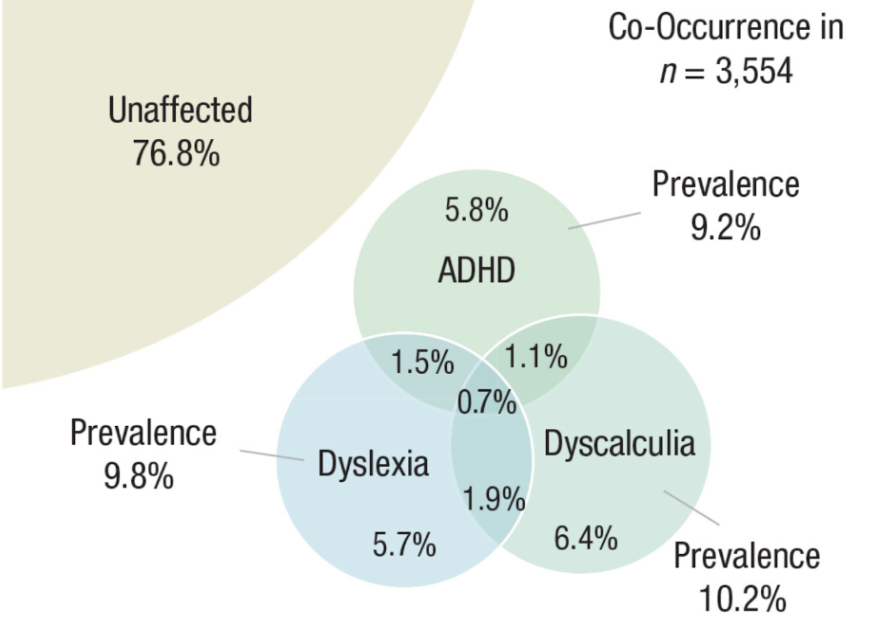
Peer-reviewed research in 2025 continued to clarify how often dyslexia and ADHD occur together. A major study by Evelien van Bergen and colleagues, published in Psychological Science, examined shared genetic and cognitive risk factors across dyslexia, ADHD, and dyscalculia using a large population sample.
The figure above illustrates one of the study’s key findings: while many children experience just one learning difference, a meaningful number experience overlapping conditions. In the sample analyzed, dyslexia and ADHD frequently co-occurred, reflecting shared challenges related to attention regulation and processing efficiency rather than entirely separate causes.
Importantly for families, the authors emphasize that co-occurrence does not mean reading intervention is ineffective. Instead, the research reinforces that structured reading instruction remains effective for students with dyslexia, including those who also have ADHD. What matters is adaptability. Programs that can adjust pacing, provide consistent structure, and support attention and engagement are better positioned to meet the needs of children with overlapping learning differences.
This growing body of research underscores an important shift in how reading support is designed. Effective programs are not one-size-fits-all. They recognize that many children bring multiple learning needs into reading instruction and require flexible, responsive support.
In 2025, the National Council on Teacher Quality (NCTQ) released updated teacher-preparation and reading-instruction profiles for New York, examining how well the state’s requirements align with the science of reading.
The New York profile highlighted variability in coursework expectations, clinical practice, and how teacher candidates are assessed on evidence-based reading instruction. NCTQ emphasized that adopting science-of-reading policies at the state level is not sufficient on its own. Without sustained investment in educator preparation and instructional support, implementation gaps persist.
These findings illustrate a broader challenge facing literacy reform. Even as early screening and intervention policies expand, teacher preparation remains a critical bottleneck for improving reading outcomes at scale.
In 2025, a University at Buffalo–led research team examined whether artificial intelligence could support earlier identification of dyslexia and dysgraphia by analyzing children’s handwriting.
Published in SN Computer Science and reported in May 2025, the study used machine-learning models to analyze features of handwritten samples, such as letter formation, spacing, and stroke patterns. The researchers found that these handwriting characteristics were meaningfully associated with known markers of dyslexia and dysgraphia.
Importantly, the authors emphasized that this approach is not a diagnostic tool. Instead, they described AI-based handwriting analysis as a potential early screening signal that could help flag students who may benefit from further evaluation. The broader idea behind the research is that handwriting, which reflects both language and motor processes, may offer an accessible, low-cost way to surface reading-related risk earlier, particularly in classroom settings.
Taken together, the most important developments of 2025 point in the same direction. Early identification matters. High-quality tutoring matters. Educator preparation matters. And tools, including AI, are only as effective as the instructional science guiding them.
Across policy shifts like California’s universal K–2 screening, national tutoring standards, and peer-reviewed research on dyslexia and ADHD, the message is consistent: reading outcomes improve when instruction is explicit, systematic, and grounded in cognitive science. The science of reading is not a trend. It is the foundation that makes early screening meaningful, tutoring effective, and new technologies worth evaluating.
At the same time, 2025 also revealed how much work remains outside formal systems. New research from HarperCollins UK found that fewer parents are reading aloud to young children than in previous years, with a steady decline in shared reading among families with children ages 0–4. This matters because early language exposure and shared reading at home shape vocabulary, comprehension, and confidence long before a child ever takes a screener or enters an intervention program.
There is no instant fix. But there is growing clarity about what works and why. Strengthening reading outcomes requires acting early, intervening intentionally, and supporting children both in and out of school. For students who struggle, reading does not wait. Neither should support.
If you’re looking for support grounded in the science of reading, Sprout Labs offers research-backed programs designed to meet children where they are and help them build reading skills with confidence. Learn more about our programs today.
Sources:
California Department of Education. Reading Difficulties Risk Screener Initiative.
https://www.cde.ca.gov/be/cc/rd/index.asp
HarperCollins UK. New research reveals that parents are losing the love of reading aloud. 2025
https://corporate.harpercollins.co.uk/press-releases/new-research-reveals-that-parents-are-losing-the-love-of-reading-aloud/
National Council on Teacher Quality. State Reading Profiles (New York). March 2025
https://www.nctq.org/wp-content/uploads/2025/03/NewGraph_NY_TeacherPrepReviewReadingUpdated.pdf
National Student Support Accelerator (Stanford). Tutoring Quality Standards. Nov 12, 2025
https://nssa.stanford.edu/tqis/quality-standards
Nealon, C. (2025). AI handwriting analysis may help identify dyslexia. University at Buffalo
https://www.buffalo.edu/news/releases/2025/05/detect-dyslexia-with-AI-powered-handwriting-analysis.html
van Bergen, E., et al. (2025). Co-Occurrence and Causality Among ADHD, Dyslexia, and Dyscalculia. Psychological Science
https://journals.sagepub.com/doi/full/10.1177/09567976241293999

Courtney Glazer is a Content Strategist at Sprout Labs, where she creates accessible, science-based resources that guide families through early literacy challenges and highlight effective paths toward reading success.


